10ml to tsp: How Many Teaspoons Are in 10 Milliliters?
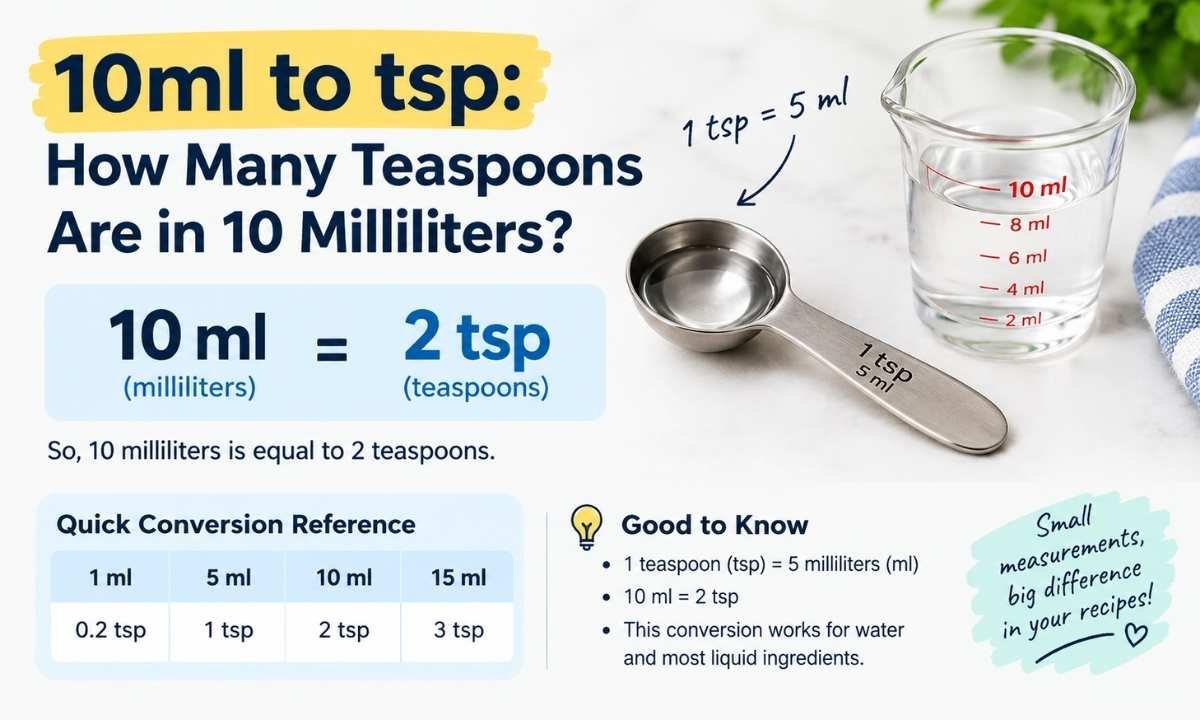
10 ml equals 2 teaspoons using the metric and nutrition label teaspoon of 5 ml. With the exact US customary teaspoon of 4.93 ml, 10 ml is 2.03 teaspoons. For cooking, use 2 level teaspoons.
This guide explains the conversion and why answers differ by a small amount. It also shows how to measure 10 ml correctly with common kitchen tools, and it ends with a medicine dosing safety section.
10 ml to tsp: The Quick Answer
| Measurement | Result |
|---|---|
| 10 ml in metric teaspoons (5 ml) | 2 tsp |
| 10 ml in US customary teaspoons | 2.03 tsp |
| 10 ml in tablespoons (15 ml) | 0.67 tbsp |
| 10 ml in UK dessert spoons (10 ml) | 1 dessert spoon |
The table shows why people see slightly different answers online. Cooks usually round to 2 teaspoons because the difference is only 0.14 ml. That gap is far too small to change the result of a recipe.
How to Convert 10 ml to Teaspoons
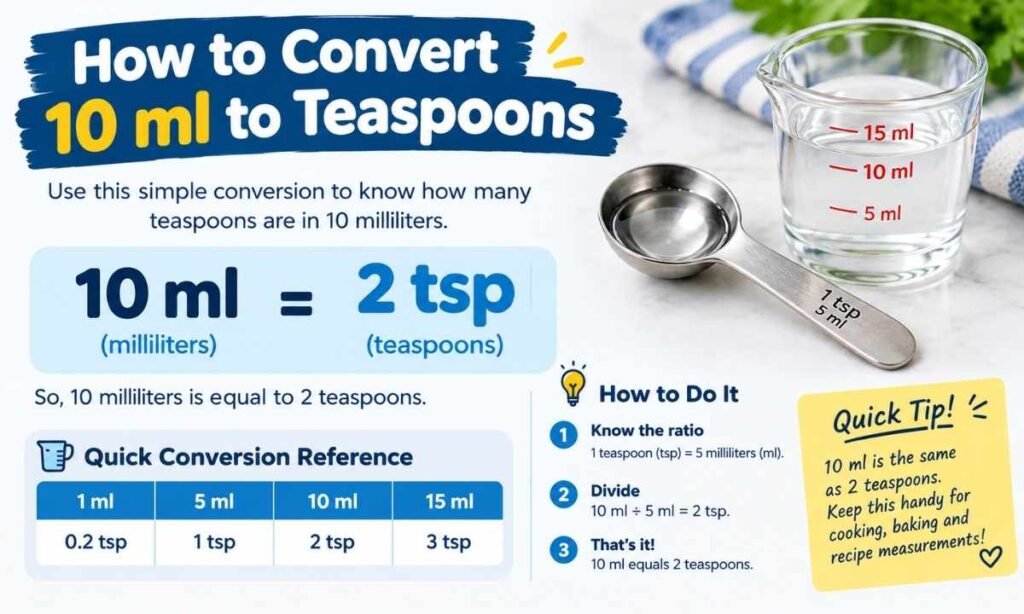
The formula is simple. Divide the milliliters by 5 for the metric teaspoon. Dividing 10 by 5 gives 2. For the US customary teaspoon, divide by 4.92892, which gives 2.0288 and rounds to 2.03 teaspoons.
Step by Step Method
- Start with 10 ml.
- Choose the teaspoon size your recipe or label uses, usually 5 ml.
- Divide 10 by that size.
- Round to a practical amount, such as 2 teaspoons.
A Quick Mental Shortcut
Remember that 5 ml is one teaspoon and 15 ml is one tablespoon. From those two anchors you can estimate most small conversions in seconds. Ten is double five, so 10 ml is two teaspoons.
Why Teaspoon Sizes Differ
A teaspoon is not one universal unit. The US customary teaspoon is one third of a US tablespoon, which works out to about 4.93 ml. The metric teaspoon is a round 5 ml, which keeps the arithmetic simple.
In the US, food labels follow a rule that sets one teaspoon at exactly 5 ml for nutrition facts. Labels and kitchen spoons therefore agree for practical purposes, even though the customary value is slightly smaller.
Teaspoon Sizes by System
| System | 1 tsp in ml | 10 ml in tsp |
|---|---|---|
| Metric and US nutrition label | 5 | 2.00 |
| US customary | 4.93 | 2.03 |
| UK and Australia (metric spoon) | 5 | 2.00 |
10 ml in Other Kitchen Units
Tablespoons are the next common unit. A US tablespoon is about 14.79 ml, so 10 ml is roughly 0.68 tablespoons. Using the 15 ml label tablespoon, 10 ml is exactly two thirds of a tablespoon.
| Unit | 10 ml equals |
|---|---|
| Teaspoons (metric) | 2 |
| Teaspoons (US customary) | 2.03 |
| Tablespoons (15 ml) | 0.67 |
| US fluid ounces | 0.34 |
| US cups | 0.04 |
| Cubic centimeters (cc) | 10 |
Fluid ounces and cups are rarely useful at this size, but they show how small 10 ml is. It is about one third of a fluid ounce and roughly four hundredths of a cup.
Teaspoon Abbreviations to Know
Recipes write teaspoons as tsp or a lowercase t. A capital T or the abbreviation tbsp means tablespoon. Mixing them up triples the amount, so 2 tsp read as 2 tbsp becomes 30 ml instead of 10 ml.
Does the Type of Liquid Change 10 ml?
No. Milliliters and teaspoons both measure volume, so 10 ml of any liquid fills the same space and equals 2 teaspoons. Only the weight changes with the liquid because each liquid has a different density.
How to Measure 10 ml Accurately
The most accurate tool is a graduated syringe or measuring cup marked in milliliters. If you only have spoons, fill a standard 5 ml measuring teaspoon to the brim twice and level each with a knife edge.
Use a proper measuring spoon, not a cutlery spoon. Tableware teaspoons vary widely, and many hold noticeably more or less than 5 ml. A set sold as measuring spoons is the reliable choice for 10 ml.
Choosing the Right Tool
Different tools suit different jobs, and 10 ml is a small enough amount that tool choice affects accuracy. The table compares four common options. Accuracy depends on leveling spoons and reading cups at eye level.
| Tool | Best use | Accuracy at 10 ml |
|---|---|---|
| Oral syringe | Medicine and small liquids | High |
| Measuring spoons | Cooking | Good when leveled |
| Small measuring cup | Larger liquid amounts | Lower |
| Cutlery spoon | Nothing precise | Poor |
Using a Syringe
Oral syringes marked in milliliters are inexpensive and give the most precise 10 ml measure. Draw liquid up to the 10 ml line, then check the mark carefully at eye level before you use it.
Common Measuring Mistakes
- Heaping the spoon instead of leveling it
- Using a dinner spoon in place of a measuring spoon
- Leaving thick liquid behind on the spoon
- Reading a measuring cup from above instead of at eye level
Measuring 10 ml of Medicine Safely
If 10 ml is a medicine dose, use the dosing syringe or cup that came with the product. Do not use a kitchen spoon. Household spoons vary in size, and an inaccurate dose of liquid medicine can be harmful.
Many liquid medicines list doses in milliliters for this reason. If a label shows teaspoons only, ask a pharmacist how that converts to the device you have. Never guess, and follow the instructions from your doctor or the package.
Recipes That Call for 10 ml
Recipes from outside the US often list small liquid amounts in milliliters rather than spoons. A recipe asking for 10 ml expects you to use 2 level teaspoons, or one UK dessert spoon if you own one.
When Is 2 Teaspoons Close Enough?
For most cooking, 2 teaspoons is the correct answer for 10 ml. The 0.14 ml difference from the exact US customary value is smaller than the error from a slightly heaped spoon. Leveling matters more than the decimal.
Baking and precise preparations deserve more care. Use a graduated measure marked in milliliters when exactness matters. Water weighs about 1 gram per milliliter, so 10 ml of water is about 10 grams, but other liquids differ.
The gap between 4.93 ml and 5 ml is tiny for one spoonful. Across 20 teaspoons, the difference reaches about 1.4 ml. For small amounts like 10 ml, the gap is only 0.14 ml, which you can ignore.
Reference Chart: Milliliters to Teaspoons
A short reference chart helps when your recipe uses amounts near 10 ml. These values use the 5 ml teaspoon, which is the standard for nutrition labels and metric kitchen spoons, so they suit most recipes.
| Milliliters | Teaspoons |
|---|---|
| 2.5 ml | 0.5 tsp |
| 5 ml | 1 tsp |
| 7.5 ml | 1.5 tsp |
| 10 ml | 2 tsp |
| 15 ml | 3 tsp |
| 20 ml | 4 tsp |
| 25 ml | 5 tsp |
| 30 ml | 6 tsp |
Going the other way, 2 metric teaspoons equal exactly 10 ml. Two US customary teaspoons equal 9.86 ml. Either way, the practical difference is negligible, so 2 level teaspoons is a safe match for 10 ml in recipes.
Frequently Asked Questions
How many teaspoons is 10 ml?
10 ml is 2 teaspoons using the 5 ml metric teaspoon, or 2.03 teaspoons using the US customary teaspoon.
Is 10 ml the same as 2 tsp?
Yes for cooking. The exact US customary value is 2.03 tsp, a difference of about 0.14 ml.
How many tablespoons is 10 ml?
About 0.67 tablespoons with a 15 ml tablespoon, or 0.68 with the US customary tablespoon.
Is 10 ml the same as 10 cc?
Yes. One cubic centimeter equals one milliliter, so 10 cc is 10 ml.
How many ml is 2 teaspoons?
2 metric teaspoons equal 10 ml. 2 US customary teaspoons equal about 9.86 ml.
Can I use a kitchen spoon to measure 10 ml?
Only a proper measuring spoon is reliable. Cutlery spoons vary in size, so avoid them for medicine.
How many dessert spoons is 10 ml?
A UK dessert spoon is commonly 10 ml, so 10 ml is one dessert spoon.
Does 10 ml of oil equal 2 teaspoons too?
Yes. Teaspoons measure volume, so 10 ml of any liquid is 2 teaspoons.
Conclusion
10 ml is 2 teaspoons for nearly every practical purpose, or 2.03 teaspoons by the exact US customary definition. Use two level metric measuring spoons for cooking, and a marked syringe or cup for any liquid medicine.
Keep the reference tables from this guide nearby whenever you cook with metric recipes. With the right spoon and a level measure, the small differences between teaspoon definitions will not noticeably affect your final result.