How Many ML in a Tablespoon? Exact Conversions and Charts
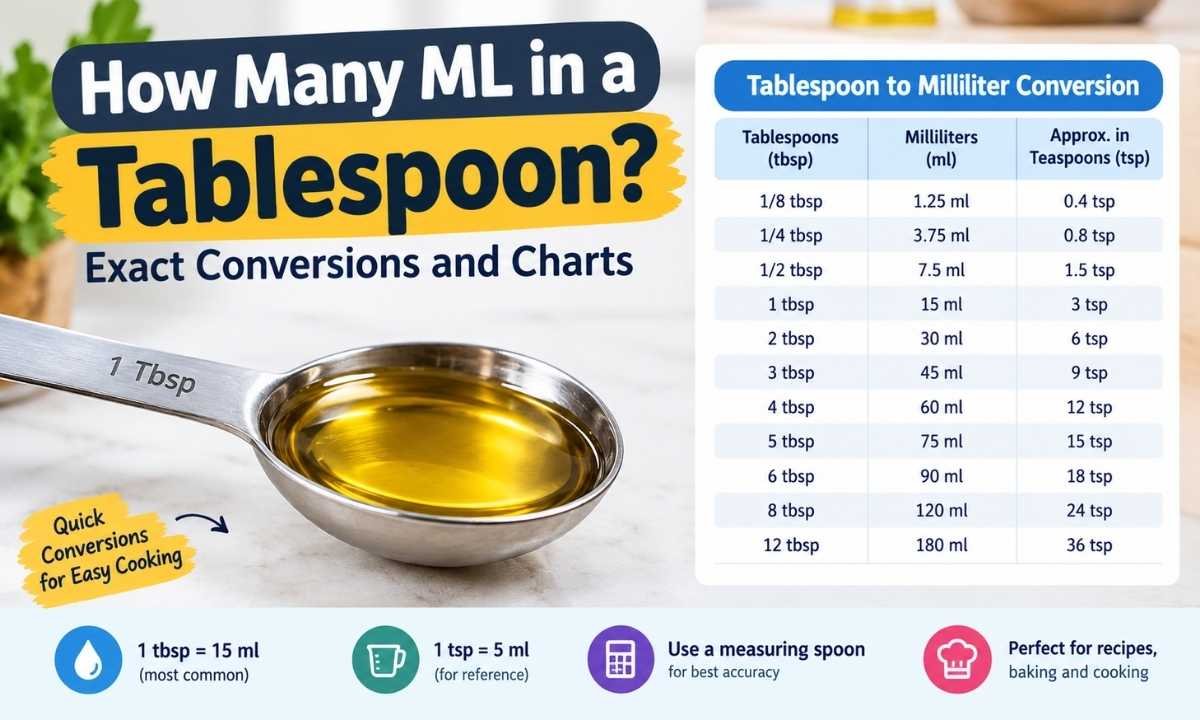
One US tablespoon equals 14.79 ml, and most recipes round that to 15 ml. A metric tablespoon is exactly 15 ml, while an Australian tablespoon holds 20 ml. This guide covers exact values, conversion charts, and measuring tips.
Quick Answer: How Many ML Are in One Tablespoon?
For almost every recipe, one tablespoon equals 15 ml. That figure matches the metric tablespoon and the rounded US value used on nutrition labels. The exact US tablespoon is slightly smaller, but the gap rarely changes how food turns out.
Recipes use four tablespoon sizes, and knowing which one applies prevents most measuring errors. The list below shows each size in milliliters, starting with the US spoon that most American cookbooks assume and ending with the older British spoon.
- US tablespoon: 14.79 ml (about 15 ml)
- Metric tablespoon: 15 ml
- Australian tablespoon: 20 ml
- Old UK imperial tablespoon: 17.76 ml
If you do not know where a recipe comes from, use 15 ml. Recipes from Australia are the main exception, because their larger spoon adds about one third more volume than the standard 15 ml version.
Tablespoon Sizes by Country
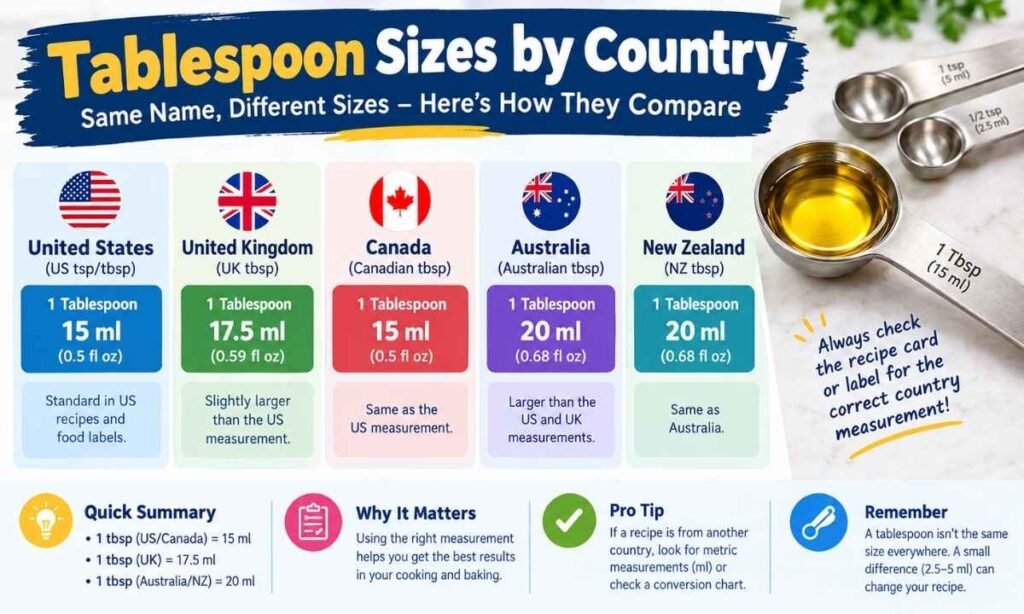
The word tablespoon does not describe one fixed volume worldwide. Each country settled on its own definition over time, and some later moved to the metric system. The table below shows the sizes most home cooks run into.
| Type | Volume in ml | Where it is used |
|---|---|---|
| US tablespoon | 14.79 | United States |
| Metric tablespoon | 15 | Canada, UK, Europe, New Zealand |
| Australian tablespoon | 20 | Australia |
| Imperial tablespoon | 17.76 | Older UK recipes |
US Tablespoon
The US customary tablespoon is defined as half of a US fluid ounce. That works out to 14.7868 ml. American nutrition labels treat one tablespoon as 15 ml, and most home cooks do the same when measuring.
Metric Tablespoon
The metric tablespoon is a clean 15 ml, which makes the math simple. Modern UK and Canadian recipes use it, and so do many European cookbooks. It also equals three metric teaspoons of 5 ml each.
Australian Tablespoon
Australia uses a 20 ml tablespoon, equal to four 5 ml teaspoons. This is the one size that really changes a result. Using a 15 ml spoon for a 20 ml recipe leaves you a quarter short.
Old UK Imperial Tablespoon
Before metrication, British recipes used an imperial tablespoon of about 17.76 ml. You will see it in vintage cookbooks and family recipe cards. Modern UK cooks usually read those older tablespoons as 15 ml, though results can run slightly lean.
Tablespoon to ML Conversion Chart
The chart below lists the exact US value beside the rounded 15 ml value. Use the exact column for precise work such as small batch baking, and the rounded column for daily cooking. Both are close enough for most dishes.
| Tablespoons | Exact US (ml) | Rounded (ml) |
|---|---|---|
| 1 | 14.79 | 15 |
| 2 | 29.57 | 30 |
| 3 | 44.36 | 45 |
| 4 | 59.15 | 60 |
| 5 | 73.93 | 75 |
| 6 | 88.72 | 90 |
| 8 | 118.29 | 120 |
| 10 | 147.87 | 150 |
| 12 | 177.44 | 180 |
| 16 | 236.59 | 240 |
ML to Tablespoon Conversion Chart
Going the other way is just as common, especially when a recipe lists milliliters but your measuring set only shows spoons. The chart shows how many tablespoons fit into popular milliliter amounts using both the US and metric spoons.
| Milliliters | US tablespoons | Metric tablespoons |
|---|---|---|
| 5 | 0.34 | 0.33 |
| 10 | 0.68 | 0.67 |
| 15 | 1.01 | 1.00 |
| 20 | 1.35 | 1.33 |
| 30 | 2.03 | 2.00 |
| 50 | 3.38 | 3.33 |
| 100 | 6.76 | 6.67 |
| 250 | 16.91 | 16.67 |
Conversion Formulas
To convert tablespoons to milliliters, multiply the number of tablespoons by 14.7868 for the US spoon, or by 15 for the metric spoon. For example, 2.5 tablespoons equals 36.97 ml in US units and 37.5 ml in metric units.
To convert milliliters to tablespoons, divide the milliliters by 14.7868 or by 15. For example, 45 ml equals 3.04 US tablespoons or exactly 3 metric tablespoons. Rounding to the nearest quarter spoon is practical in the kitchen.
Fractions of a Tablespoon in ML
Recipes often call for half or quarter tablespoons, and those amounts are easy to miss on a standard spoon set. The table lists the common small measures, including the teaspoon, which is one third of a tablespoon.
| Measure | Exact US (ml) | Rounded (ml) |
|---|---|---|
| 1/4 tablespoon | 3.70 | 3.75 |
| 1/3 tablespoon (1 teaspoon) | 4.93 | 5 |
| 1/2 tablespoon | 7.39 | 7.5 |
| 2/3 tablespoon (2 teaspoons) | 9.86 | 10 |
| 3/4 tablespoon | 11.09 | 11.25 |
Tablespoons, Fluid Ounces and Cups
Tablespoons connect neatly to other US kitchen units. Two tablespoons make one fluid ounce, which is 29.57 ml. Sixteen tablespoons make one US cup, or 236.59 ml. Knowing these links helps you scale recipes up or down quickly.
- 1 US fluid ounce = 2 tablespoons = 29.57 ml
- 1/4 US cup = 4 tablespoons = 59.15 ml
- 1/2 US cup = 8 tablespoons = 118.29 ml
- 1 US cup = 16 tablespoons = 236.59 ml
A metric cup is 250 ml, which equals about 16.67 metric tablespoons. That small difference explains why a recipe written for metric cups can come out slightly different if you measure it with a US cup and spoons.
Does the Ingredient Change the Volume?
No. A tablespoon measures volume, so a level tablespoon of water, oil, honey, or syrup fills the same space. What changes is weight. Honey is denser than water, so a tablespoon of honey weighs noticeably more than one of water.
Water is the easy reference point, because one milliliter of water weighs about one gram. A tablespoon of water therefore weighs close to 15 grams. For other ingredients, a kitchen scale gives better accuracy than any spoon.
Level Tablespoon vs Heaped Tablespoon
Unless a recipe says otherwise, a tablespoon means a level one. Fill the spoon, then sweep the flat edge of a knife across the top so the surface sits even with the rim, with no mound above it.
A heaped tablespoon holds noticeably more, depending on how the ingredient piles up. Powders such as flour and cocoa mound easily, so a heaped spoon can hold far more than intended. Liquids cannot heap, so fill them to the brim.
How to Measure a Tablespoon Without a Measuring Spoon
A dinner spoon is a poor substitute, because everyday cutlery varies widely in size and shape. If you lack a proper measuring spoon, try one of the numbered methods below, which all rely on known volumes or weights instead.
- Use a small measuring jug or cup marked in milliliters and pour in 15 ml.
- Weigh water on a kitchen scale and aim for about 15 grams per tablespoon.
- Use an oral syringe or small marked cup to measure 15 ml of liquid.
- Count three level teaspoons of 5 ml each to make one metric tablespoon.
Each method works best for liquids. For dry ingredients, weigh them whenever the recipe gives grams, since packing and settling change how much fits on a spoon. A scale removes that variation completely and keeps every batch consistent.
Capital T vs Lowercase t: Avoid the Most Common Mix-Up
Recipe abbreviations cause more errors than spoon sizes. A lowercase t or tsp means teaspoon, while a capital T, Tbsp, or tbsp means tablespoon. Mixing them up triples the amount of an ingredient or cuts it to a third.
This matters most for strong flavors. Three tablespoons of salt instead of three teaspoons would completely ruin a dish. When a handwritten recipe is unclear, compare the quantity against similar published recipes before you start cooking.
Tablespoon Measurements for Medicine
Do not use kitchen spoons to measure liquid medicine. Cutlery and even measuring spoons can vary, and a small error matters more with medicine than with food. Use the dosing cup, oral syringe, or spoon supplied with the product.
If a label states a dose in tablespoons, one tablespoon is 15 ml on most labels. For any doubt about a dose, ask a pharmacist or doctor. This article offers cooking conversions only, not medical advice.
Common Mistakes When Converting Tablespoons to ML
Most conversion errors come from a few predictable slips that are easy to avoid once you know them. Run through the list below before you pour or scoop, especially when you are following a recipe written overseas.
- Using a 15 ml spoon for an Australian recipe that expects 20 ml
- Treating a heaped spoon as a level spoon
- Confusing teaspoon and tablespoon abbreviations
- Assuming a US cup and a metric cup hold the same amount
Frequently Asked Questions
How many ml are in 1 tablespoon?
One tablespoon is 15 ml in metric and rounded US measures. The exact US tablespoon is 14.79 ml. An Australian tablespoon is 20 ml.
How many ml are in 2 tablespoons?
Two tablespoons equal 30 ml using the rounded value, or 29.57 ml using the exact US value. This is also one US fluid ounce.
How many tablespoons are in 100 ml?
100 ml is about 6.76 US tablespoons or 6.67 metric tablespoons. For cooking, round to 6.5 or 7 tablespoons depending on the recipe.
How many ml are in half a tablespoon?
Half a tablespoon is 7.5 ml when rounded, or 7.39 ml using the exact US value. It also equals one and a half teaspoons.
Is a tablespoon 15 ml or 20 ml?
It is about 15 ml in the US, UK, Canada, and most other countries. Only Australia uses a 20 ml tablespoon, so check the recipe origin.
How many teaspoons are in a tablespoon?
Three teaspoons make one tablespoon in US and metric systems. Australia is the exception, with four 5 ml teaspoons in each 20 ml tablespoon.
How many tablespoons are in a cup?
A US cup holds 16 tablespoons, or 236.59 ml. A metric cup is 250 ml, which equals about 16.67 metric tablespoons.
Can I use a regular spoon instead of a tablespoon?
It is not reliable, because dinner spoons vary in size. Use a measuring spoon or a marked cup for accurate results.
Conclusion
A tablespoon equals 15 ml for nearly all cooking, with the exact US value at 14.79 ml. The main exception is Australia, where one tablespoon holds 20 ml. Check the recipe origin, measure level, and use the charts above.
Keep the key numbers in mind: three teaspoons make one tablespoon, two tablespoons make one fluid ounce, and sixteen tablespoons make one US cup. With these conversions, you can follow any recipe confidently without searching again.