Chipotle Nutrition Facts | The Complete Guide
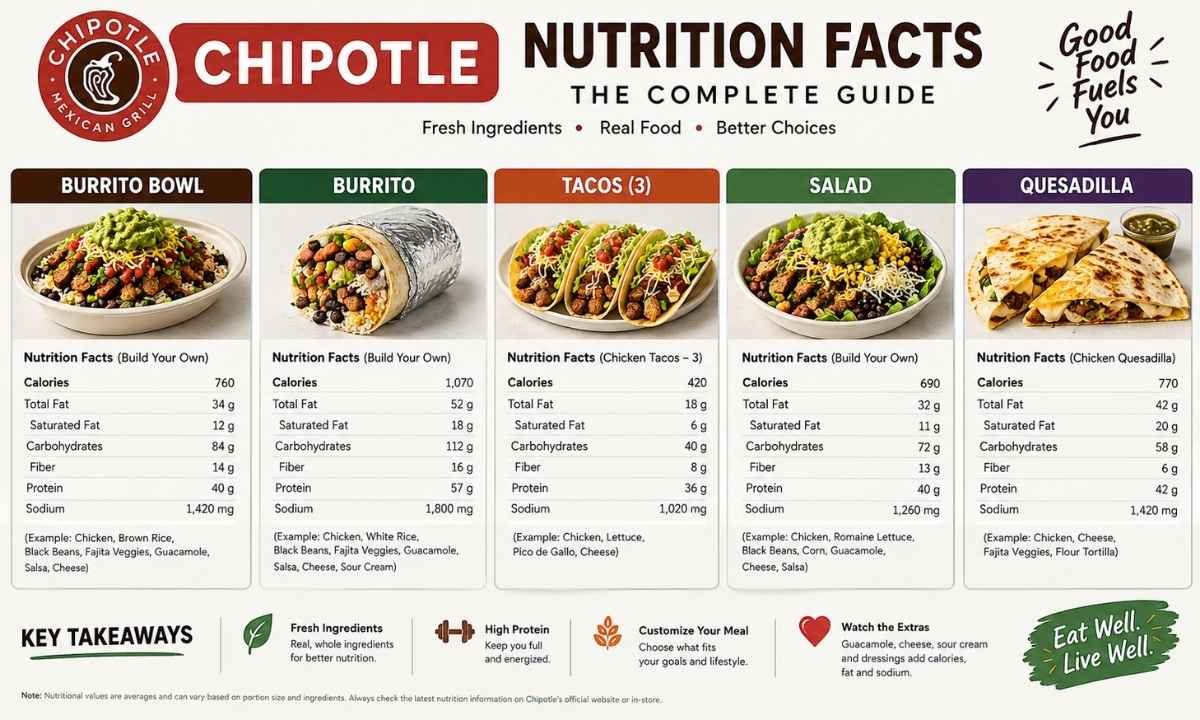
Chipotle nutrition facts depend on how you build your order. Official calorie ranges run from 420 to 910 for a burrito bowl and 740 to 1,210 for a burrito. Chicken gives the most protein; sodium needs watching.
This guide lists every ingredient with calories, protein, fat, carbs, fiber and sodium. It also explains how to read the numbers, ranks the proteins, checks allergens, and shows sample builds for keto, high-protein and vegan eaters.
All figures come from Chipotle’s published US nutrition data as reproduced by nutrition reference sites. Chipotle says serving sizes are approximations and that portions vary by order, so treat each number as a close estimate and confirm on Chipotle’s calculator.
Chipotle Nutrition Facts (Complete Ingredient Table)
Every Chipotle meal is a stack of individual ingredients, so the fastest way to understand your order is to look at each part separately. The tables below split the menu by category, with serving sizes where Chipotle lists them.
Calories appear as Cal, protein and fat are in grams (g), and sodium is in milligrams (mg). Scroll sideways on small screens if a table feels tight. Every table sticks to the same units so you can compare items quickly.
Proteins
Each protein serving is about 4 oz. Chicken leads on protein, steak has the fewest calories, and carnitas carries the most fat. Sofritas is the plant-based choice, with far less protein but the same calories as steak.
| Protein | Cal | Protein | Fat | Sodium |
|---|---|---|---|---|
| Chicken | 180 | 32 g | 7 g | 310 mg |
| Steak | 150 | 21 g | 6 g | 330 mg |
| Barbacoa | 170 | 24 g | 7 g | 530 mg |
| Carnitas | 210 | 23 g | 12 g | 450 mg |
| Sofritas | 150 | 8 g | 10 g | 560 mg |
Rice and Beans
Rice and beans form the base of most bowls and burritos. Both rice options match on calories, yet brown rice has about half the sodium of white. Beans bring the fiber, with pinto slightly ahead of black.
| Item (4 oz) | Cal | Protein | Carbs | Fiber | Sodium |
|---|---|---|---|---|---|
| Brown rice | 210 | 4 g | 36 g | 2 g | 190 mg |
| White rice | 210 | 4 g | 40 g | 1 g | 350 mg |
| Black beans | 130 | 8 g | 22 g | 7 g | 210 mg |
| Pinto beans | 130 | 8 g | 21 g | 8 g | 210 mg |
Toppings, Salsas and Extras
Salsas look harmless, but their numbers differ a lot. Green salsa is the lightest, while roasted chili-corn salsa has 80 calories and 16 g of carbs. Fresh tomato salsa has the most sodium of any regular topping.
| Item | Cal | Protein | Sodium |
|---|---|---|---|
| Fajita vegetables | 20 | 1 g | 150 mg |
| Tomatillo-green salsa | 15 | 0 g | 260 mg |
| Tomatillo-red salsa | 30 | 0 g | 500 mg |
| Fresh tomato salsa | 25 | 0 g | 550 mg |
| Roasted chili-corn salsa | 80 | 3 g | 330 mg |
| Cheese | 110 | 6 g | 190 mg |
| Sour cream | 110 | 2 g | 30 mg |
| Guacamole (4 oz) | 230 | 2 g | 370 mg |
| Supergreens salad mix | 15 | 1 g | 15 mg |
Romaine lettuce adds about 5 calories. Queso blanco appears in published tables at different serving sizes, with figures from 120 to 240 calories, so check the calculator for the size you plan to order before you decide.
Bases and Wraps
The wrap you choose can change the meal more than the filling. A burrito tortilla alone adds 320 calories and 600 mg of sodium. Skipping it by ordering a bowl removes both, which is the simplest cut you can make.
| Base | Cal | Protein | Carbs | Sodium |
|---|---|---|---|---|
| Flour tortilla (burrito) | 320 | 8 g | 50 g | 600 mg |
| Flour tortilla (taco) | 80 | 2 g | 13 g | 160 mg |
| Crispy corn taco shell | 70 | 1 g | 10 g | 0 mg |
| Supergreens salad base | 15 | 1 g | 3 g | 15 mg |
Sides and Drinks
Chips are the heaviest single item on the menu. A regular bag has 540 calories, and a large bag reaches 810. The chipotle-honey vinaigrette is small in volume but high in both calories and sodium.
| Item | Cal | Fat | Carbs | Sodium |
|---|---|---|---|---|
| Chips (regular) | 540 | 25 g | 73 g | 390 mg |
| Chips (large) | 810 | 38 g | 110 g | 590 mg |
| Honey vinaigrette (2 fl oz) | 220 | 16 g | 18 g | 850 mg |
Drink options and sizes change by location, and Chipotle notes that offerings vary. Sweetened drinks add calories from sugar, while water and plain unsweetened drinks add none. Check the drinks section of the calculator for your restaurant.
How to Read Chipotle Nutrition Facts
Start with the serving size. Chipotle lists values for one standard scoop, usually about 4 oz for proteins, rice and beans. If your server gives a double portion, every number for that item doubles too.
Next, add the ingredients together yourself. Chipotle’s calculator does this for you, but doing it by hand shows where the numbers come from. Here is a sample bowl built from the figures in the tables above.
| Ingredient | Cal | Sodium |
|---|---|---|
| Chicken | 180 | 310 mg |
| Brown rice | 210 | 190 mg |
| Black beans | 130 | 210 mg |
| Fresh tomato salsa | 25 | 550 mg |
| Fajita vegetables | 20 | 150 mg |
| Cheese | 110 | 190 mg |
| Total | 675 | 1,600 mg |
This bowl provides about 51 g of protein, 22.5 g of fat, 68 g of carbs and 11 g of fiber. At 1,600 mg, the sodium is roughly 70% of the 2,300 mg daily limit used on US labels.
Follow these steps each time you build a meal:
- Pick a protein first, since it sets your calorie and protein baseline.
- Add rice or beans, and note that rice adds calories faster than beans.
- Choose salsas by sodium, not only by calories.
- Add cheese, sour cream or guacamole last, because these add the most fat per spoonful.
- Total the numbers, then compare them with your daily goals.
Percent Daily Value figures assume a 2,000 calorie diet. Your needs may be higher or lower, so use the percentages as a rough guide and not a personal target. A dietitian can help set numbers that fit your own situation.
Chipotle Protein Nutrition — Which Protein Wins?
Chicken wins on protein. It gives 32 g for 180 calories, which works out to about 17.8 g of protein per 100 calories. No other protein comes close on that ratio, and it has the lowest sodium of any meat.
The table below adds saturated fat and cholesterol so you can compare each protein on more than one measure. Protein per 100 calories is calculated from the values in the first table, then rounded to one decimal place.
| Protein | Cal | Protein | Sat fat | Cholesterol | Protein per 100 cal |
|---|---|---|---|---|---|
| Chicken | 180 | 32 g | 3 g | 125 mg | 17.8 g |
| Barbacoa | 170 | 24 g | 2.5 g | 65 mg | 14.1 g |
| Steak | 150 | 21 g | 2.5 g | 80 mg | 14.0 g |
| Carnitas | 210 | 23 g | 7 g | 65 mg | 11.0 g |
| Sofritas | 150 | 8 g | 1.5 g | 0 mg | 5.3 g |
Steak is the lowest calorie meat at 150, and it has less saturated fat than chicken. Barbacoa has strong protein, but its 530 mg of sodium is the highest among the meats. Carnitas has the most saturated fat by far.
Sofritas suits anyone avoiding animal products or cholesterol. It has the lowest protein, though, so pair it with beans if you want a fuller macro profile. Its 560 mg of sodium is also the highest of any protein option.
Chipotle Allergen Guide | Every Ingredient Checked
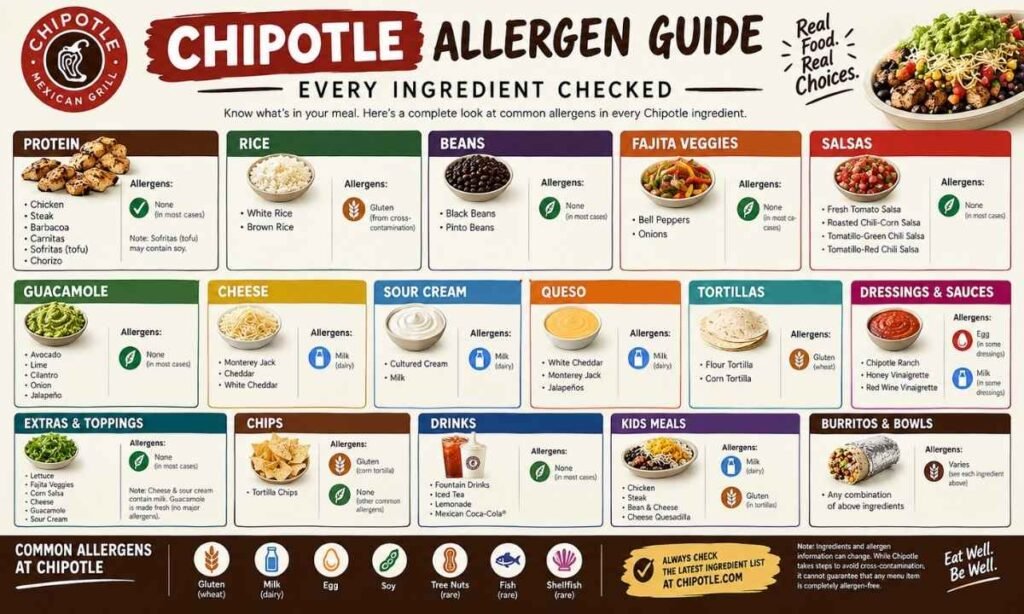
Chipotle publishes an allergen chart at chipotle.com/allergens. The menu uses only a short list of allergens as ingredients, but because food is prepared in a shared space, cross-contact can still happen at the restaurant, so mention your allergy when ordering.
Chipotle states that individual foods may touch during preparation, and that this is not reflected on the chart. Limited-time items and menu tests may also contain allergens that the page does not list, so always read the notes.
What Allergens Does Chipotle Use?
Chipotle’s chart flags milk, soy, wheat and gluten, and sulphites. Wheat and gluten are combined because every gluten-containing item at Chipotle also contains wheat. Dairy appears in cheese, queso and sour cream, all easy to skip.
Chipotle says it does not use eggs, mustard, peanuts, tree nuts, sesame, shellfish or fish as ingredients. It also states that it cannot guarantee these allergens are completely absent from its restaurants, so cross-contact remains possible.
Sulphites at Chipotle come only from vinegar, where they occur naturally below the 10 ppm level that requires labeling. The company still flags vinegar-containing items for transparency. Carnitas is made with pork, which matters for anyone who avoids it.
| Allergen | Where it appears |
|---|---|
| Wheat and gluten | Flour tortillas |
| Dairy | Cheese, queso, sour cream |
| Soy | Sofritas |
| Sulphites (from vinegar) | Items made with vinegar |
Chipotle’s live chart is the final authority on which item contains which allergen. Ingredient suppliers and recipes can change, so reread the page before ordering if you have a serious allergy, even when you have checked it before.
Gluten-Free at Chipotle
Chipotle’s advice is direct: if you avoid gluten, do not eat the flour tortillas. Bowls, salads and corn-based tacos have no gluten ingredients, which makes a bowl the simplest gluten-free order for most people, with no special requests.
People with celiac disease should read one more warning. Chipotle notes that corn items, including chips, crispy corn tortillas and corn salsa, may carry trace gluten from grains that mix with corn in the field.
If you are highly sensitive, tell the team at the start of your order that you want fresh gloves. Chipotle says it will change gloves on request, though the shared kitchen means no order can be guaranteed free of cross-contact.
Dairy-Free at Chipotle
Dairy-free ordering is simple. Skip the shredded Monterey Jack cheese, queso and sour cream, the three dairy items on the chart. Chipotle adds that its cheese and queso use vegetable-based rennet and its sour cream is cultured cream.
Chipotle says its tortillas, vegetables, rice, beans, salsas, chips and guacamole are vegan, so none of them contain dairy. Check limited-time sauces and new items separately, since those can change the allergen picture at any time.
Soy-Free at Chipotle
Soy-free eaters should skip sofritas, the tofu-based protein. Chicken, steak, barbacoa and carnitas are the alternatives, and each pairs easily with rice, beans and vegetables for a full bowl. Confirm each item against the live chart.
Because soy is listed for sofritas on reference charts, confirm this against Chipotle’s live allergen page. Menu tests and limited-time items can add soy that the main chart does not show, so recheck before each visit.
Chipotle Nutritional Value | What the Numbers Actually Mean
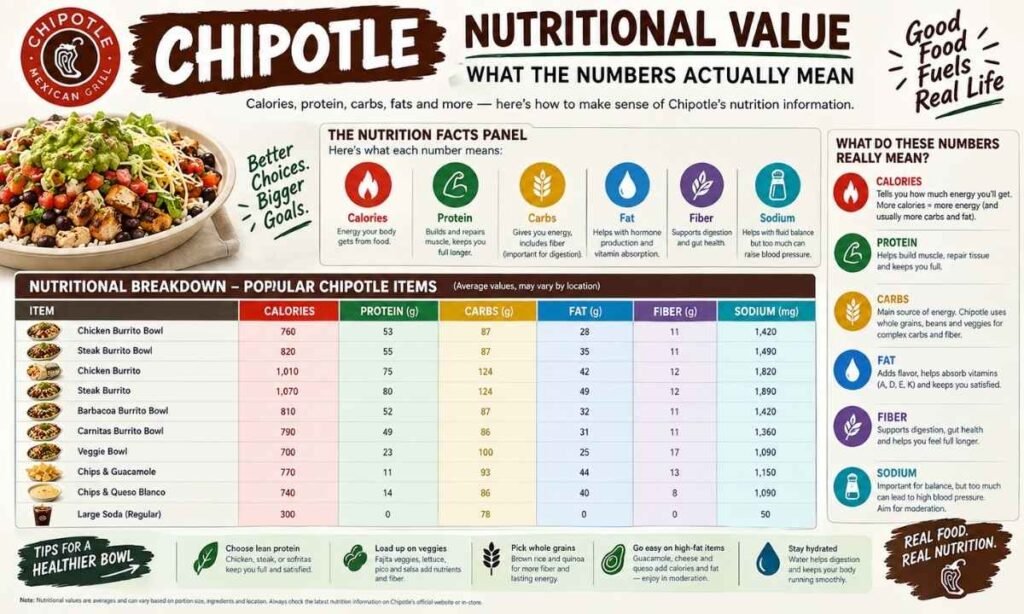
Raw numbers only help when you know the limits they are measured against. US labels use a daily value of 2,300 mg for sodium, 20 g for saturated fat, 300 mg for cholesterol and 28 g for fiber.
Those benchmarks turn the tables into practical decisions. A single Chipotle bowl can use a large share of the day’s sodium while still looking modest on calories. Saturated fat and fiber tell their own stories, as the next sections show.
Sodium — The Biggest Concern
Sodium is where Chipotle meals run highest. The honey vinaigrette has 850 mg in one 2 fl oz serving, about 37% of the daily limit. A burrito tortilla adds 600 mg, and sofritas adds 560 mg.
Salsas surprise people. Fresh tomato salsa sounds light at 25 calories but carries 550 mg of sodium. A few simple swaps lower the total without changing the meal much at all, as the table below shows.
| Swap | Sodium saved |
|---|---|
| Green salsa instead of fresh tomato salsa | 290 mg |
| Chicken instead of barbacoa | 220 mg |
| Brown rice instead of white rice | 160 mg |
| Bowl instead of burrito | 600 mg |
| Skip the vinaigrette | 850 mg |
People managing blood pressure or following a sodium-restricted diet should talk with a doctor or dietitian about a personal limit. The 2,300 mg figure is a general label benchmark and not advice tailored to any one person’s health.
Saturated Fat
Saturated fat is mostly an issue with carnitas. At 7 g per serving, one scoop supplies about 35% of the 20 g daily value. Chicken has 3 g, which is around 15%, and steak and barbacoa have 2.5 g each.
Toppings add up here too. Cheese has 8 g of total fat and sour cream has 9 g, both of which push a bowl higher. Guacamole is rich in fat as well, though a different type of fat from dairy.
Fiber and Cholesterol
Beans are the fiber source. Black beans give 7 g and pinto beans give 8 g, which covers roughly 25% and 29% of the 28 g daily value. Sofritas adds 3 g, and fajita vegetables add 1 g.
Cholesterol comes mostly from meat. Chicken has the most at 125 mg, about 42% of the 300 mg daily value. Steak, barbacoa and carnitas range from 65 to 80 mg, and sofritas has none at all.
Chipotle Nutrition by Diet Type
The three builds below are worked examples calculated from the tables in this guide. They are starting points, not medical or dietitian advice. Portion size at your restaurant can shift every total, so treat them as estimates.
Keto Nutrition Facts at Chipotle
A keto bowl removes rice, beans, tortillas, corn salsa and the vinaigrette. Carnitas, supergreens, fajita vegetables, cheese and sour cream make a workable base with about 8 g of net carbs, calculated as total carbs minus fiber.
| Build | Cal | Protein | Fat | Net carbs | Sodium |
|---|---|---|---|---|---|
| Carnitas, supergreens, fajita veg, cheese, sour cream | 465 | 33 g | 29 g | 8 g | 835 mg |
Many keto plans cap net carbs somewhere between 20 and 50 g per day, so check what your plan allows. Guacamole is a common keto addition, but confirm its carb count in the calculator before adding it.
High-Protein Nutrition Facts at Chipotle
Double chicken is the strongest high-protein move. Two scoops give 64 g of protein for 360 calories. Add black beans, fajita vegetables and green salsa to round out the bowl with fiber and flavor, reaching 525 calories in total.
| Build | Cal | Protein | Fiber | Sodium |
|---|---|---|---|---|
| Double chicken, black beans, fajita veg, green salsa | 525 | 73 g | 8 g | 1,240 mg |
Double protein usually costs extra, so confirm the price when you order. The sodium is also high at 1,240 mg, so skip the cheese and the vinaigrette to keep the total from climbing any higher than it already is.
Vegan Nutrition Facts at Chipotle
Chipotle says its sofritas, tortillas, vegetables, rice, beans, salsas, chips and guacamole are vegan. Vegans should avoid the meats, shredded cheese, queso, sour cream and honey vinaigrette, according to Chipotle’s own guidance for vegans on its allergen page.
| Build | Cal | Protein | Carbs | Fiber | Sodium |
|---|---|---|---|---|---|
| Sofritas, brown rice, black beans, fajita veg, green salsa | 525 | 21 g | 76 g | 13 g | 1,370 mg |
This bowl is high in carbs and fiber, with moderate protein. Adding guacamole brings another 230 calories and more fat. Cross-contact with animal products can happen on shared utensils, so ask the team if that matters to you.
Frequently Asked Questions
How many calories are in a Chipotle burrito bowl?
Chipotle’s published range for a burrito bowl is 420 to 910 calories, depending on the protein, rice, beans and toppings you choose.
Which Chipotle protein has the most protein?
Chicken has the most protein, with 32 g per serving for 180 calories.
Is Chipotle gluten-free?
Everything except the flour tortilla is made without gluten ingredients, but corn items may carry trace gluten from field co-mingling, according to Chipotle.
Which Chipotle item has the most sodium?
The chipotle-honey vinaigrette has the most, at 850 mg per 2 fl oz serving.
Does Chipotle use peanuts or tree nuts?
Chipotle does not use them as ingredients, but it states that it cannot guarantee their complete absence from its restaurants.
Is Chipotle vegan-friendly?
Yes. Sofritas, rice, beans, vegetables, salsas, chips, guacamole and tortillas are vegan, while meats, cheese, queso, sour cream and the vinaigrette are not.
Where can I find the official Chipotle nutrition numbers?
Use the nutrition calculator and the allergen page at chipotle.com for current official figures.
Final Thoughts
A Chipotle meal can fit almost any eating plan once you know which ingredients carry the weight. Protein choice, wrap choice and salsa choice decide most of the calories and sodium, and a few swaps change the total quickly.
For the cleanest numbers, build your order in Chipotle’s own calculator and check the allergen chart before each visit. Menus and limited-time items change, and the official pages are always the final word on what a meal contains.